


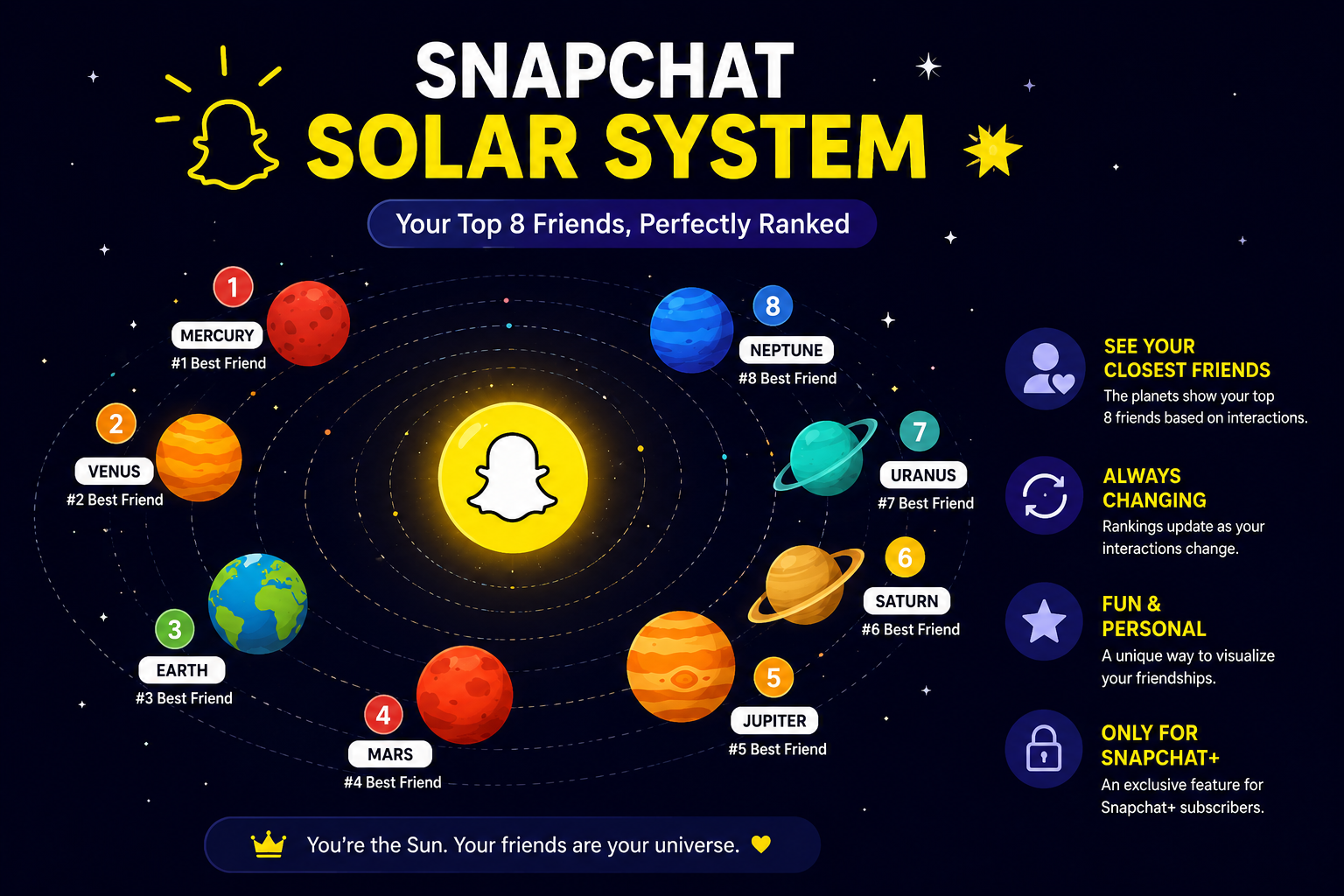
Snapchat has always introduced creative ways for users to interact with friends, but one of its most talked-about premium features is the snapchat solar system. Many Snapchat+ subscribers are curious about what the planets mean, how the rankings work, and why certain friends appear as Mercury while others are assigned Neptune.
Understanding the snapchat solar system can help users make sense of their friendships and interactions inside the app. Although the feature is designed to be fun and engaging, it has sparked plenty of conversations among users who want to know how their rankings are determined.
In 2026, the feature remains one of the most recognizable parts of Snapchat+, offering a unique way to visualize your closest friends. This guide explains everything you need to know, including planet meanings, friend rankings, badges, and how the system actually works.
What Is Snapchat Solar System?
The snapchat solar system is a feature available exclusively to Snapchat+ subscribers. It uses the idea of the solar system to represent your closest friends.
In this system, you are considered the Sun. Your top eight friends are assigned planets according to how often you interact with them. The closer a planet is to the Sun, the closer that friend is considered within your Snapchat activity.
Unlike traditional friend lists, this visual ranking system creates a playful experience that many users find entertaining.
The feature is based on communication patterns rather than real-world relationships. Frequent snaps, chats, and interactions all influence the order.
How the Snapchat Friend Solar System Works
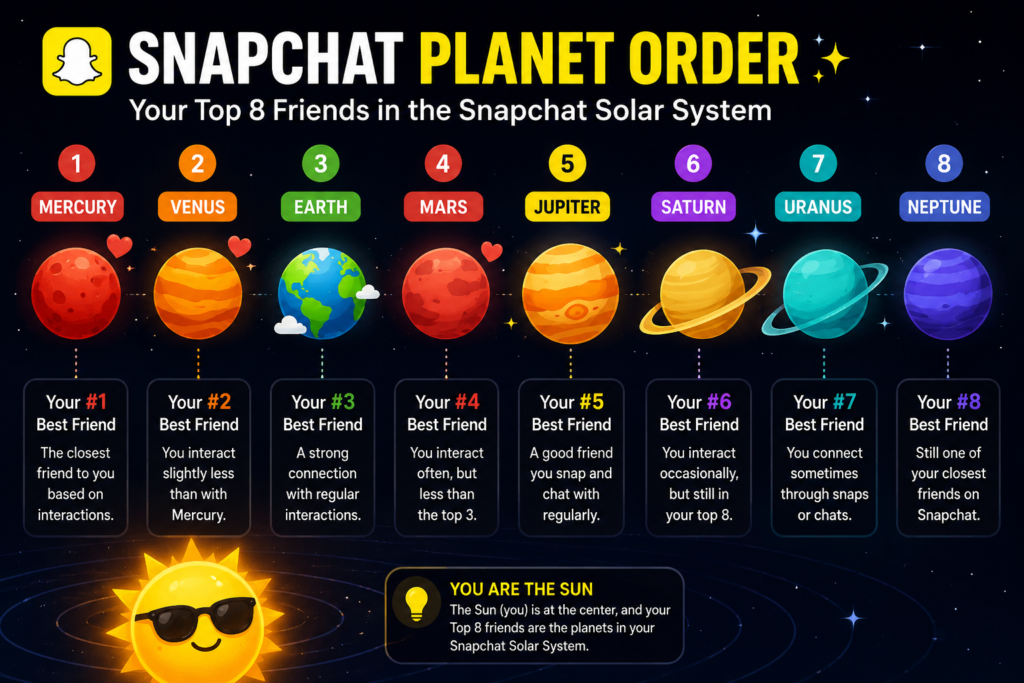
The snapchat solar system organizes your eight closest friends into planets based on your interaction levels.
The ranking works as follows:
- Mercury – #1 Best Friend
- Venus – #2 Best Friend
- Earth – #3 Best Friend
- Mars – #4 Best Friend
- Jupiter – #5 Best Friend
- Saturn – #6 Best Friend
- Uranus – #7 Best Friend
- Neptune – #8 Best Friend
These rankings change over time. If you communicate more with one friend than another, their position may move closer to the Sun.
Snapchat constantly updates these relationships based on recent activity, making the experience dynamic rather than permanent.
Snapchat Planet Order Explained
The planet order follows the same sequence as the real solar system. However, each planet carries a different meaning inside Snapchat.
Mercury
Mercury represents your number-one best friend.
This person is usually the individual with whom you exchange the most snaps and messages. Mercury is shown as a small red planet surrounded by hearts and stars.
Venus
Venus symbolizes your second-closest friend.
Although interactions remain strong, they are slightly lower compared with your Mercury friend.
Earth
Earth indicates your third-ranked friend.
It often includes moon icons and heart symbols, making it visually distinct.
Mars
Mars represents your fourth-best friend.
Users assigned to Mars still have high interaction levels but are slightly further away in terms of engagement.
Jupiter, Saturn, Uranus, and Neptune Meanings
Jupiter
Jupiter belongs to your fifth closest friend.
The planet typically appears orange with colorful stars surrounding it.
Saturn
Saturn represents the sixth position.
Its rings make it easy to recognize among the other planets.
Uranus
Uranus corresponds to the seventh spot in the ranking.
Although interactions are less frequent, this friend still belongs to your top circle.
Neptune
Neptune is the eighth and final position in the snapchat solar system.
Friends represented by Neptune are still among your closest contacts, but they receive fewer interactions compared to Mercury or Venus.
Meaning Behind Friend Rankings
Many people assume these rankings measure emotional closeness, but that is not necessarily true.
Snapchat mainly evaluates:
- Snap frequency
- Chat activity
- Recent interactions
- Story engagement
- Mutual communication
Because of this, someone you know casually may rank higher than a lifelong friend simply because you exchange more snaps with them.
The snapchat solar system focuses on digital activity rather than personal importance.
Best Friends Badge and Friends Badge
Two symbols often create confusion among users.
Best Friends Badge
The Best Friends badge means you are both among each other’s top friends.
This represents a mutual relationship and stronger interaction patterns.
Friends Badge
The Friends badge indicates that one person appears in the other’s best friend list, but the ranking is not necessarily mutual.
These badges help users understand how their friendships are reflected within Snapchat’s algorithm.
How Snapchat Calculates Rankings
Snapchat has never publicly revealed its complete algorithm. However, user experiences suggest several factors contribute to rankings.
These include:
- Number of snaps exchanged.
- Frequency of conversations.
- Story replies.
- Shared interactions.
- Recent activity patterns.
The snapchat solar system updates automatically, which means rankings can change without warning.
Someone who is currently Mercury could become Venus or Earth after a few weeks of reduced interaction.
Why Some Users Cannot Access Snapchat Solar System
Not everyone can see this feature.
Several reasons may explain why:
Snapchat+ Subscription Is Required
The feature belongs to Snapchat’s premium service. Users without Snapchat+ will not have access.
Feature May Be Disabled
Snapchat has occasionally changed default settings. Some users need to manually enable Friend Solar System from the app settings.
Regional Rollouts
Certain updates appear gradually across countries, meaning availability may differ.
Application Needs Updating
Older versions of Snapchat may not support the latest visual features.
Keeping the app updated often solves the issue.
Why Snapchat Made This Feature Popular
The snapchat solar system became popular because it transforms friendship rankings into something visual and interactive.
Instead of simple lists, users receive colorful planets that make the experience more engaging.
Several reasons explain its popularity:
- Unique design.
- Easy-to-understand rankings.
- Social curiosity.
- Exclusive Snapchat+ appeal.
- Constant updates.
The feature also encourages users to stay active within the platform.
Privacy and Social Concerns
Despite its popularity, some users have criticized the snapchat solar system.
Critics argue that ranking friends can create unnecessary comparisons and misunderstandings.
Common concerns include:
- Feeling disappointed by rankings.
- Increased social pressure.
- Misinterpreting digital interactions.
- Friendship jealousy.
Because of these concerns, Snapchat previously adjusted certain visibility settings and made the feature optional for some users.
Ultimately, planet positions should be viewed as entertainment rather than a reflection of real-life relationships.
Common Misconceptions About Snapchat Planets
Several myths surround this feature.
It Does Not Show Who Loves You Most
Planet positions only reflect activity levels.
Rankings Change Frequently
Your Mercury friend today may become Venus next week.
It Is Not Public
Only the users involved can see these friendship indicators.
The Feature Is Exclusive
Non-subscribers cannot access the Friend Solar System.
Real-Life Friendship Doesn’t Determine Rankings
Daily interactions have a greater impact than emotional connections.
Tips for Understanding Snapchat Rankings
To use the snapchat solar system wisely, remember these practical tips:
- Treat it as a fun feature.
- Avoid comparing friendships too seriously.
- Understand that activity influences rankings.
- Expect rankings to change regularly.
- Focus on genuine relationships rather than digital scores.
Many users enjoy the feature most when they see it as entertainment rather than competition.
Why Snapchat Solar System Remains Relevant in 2026
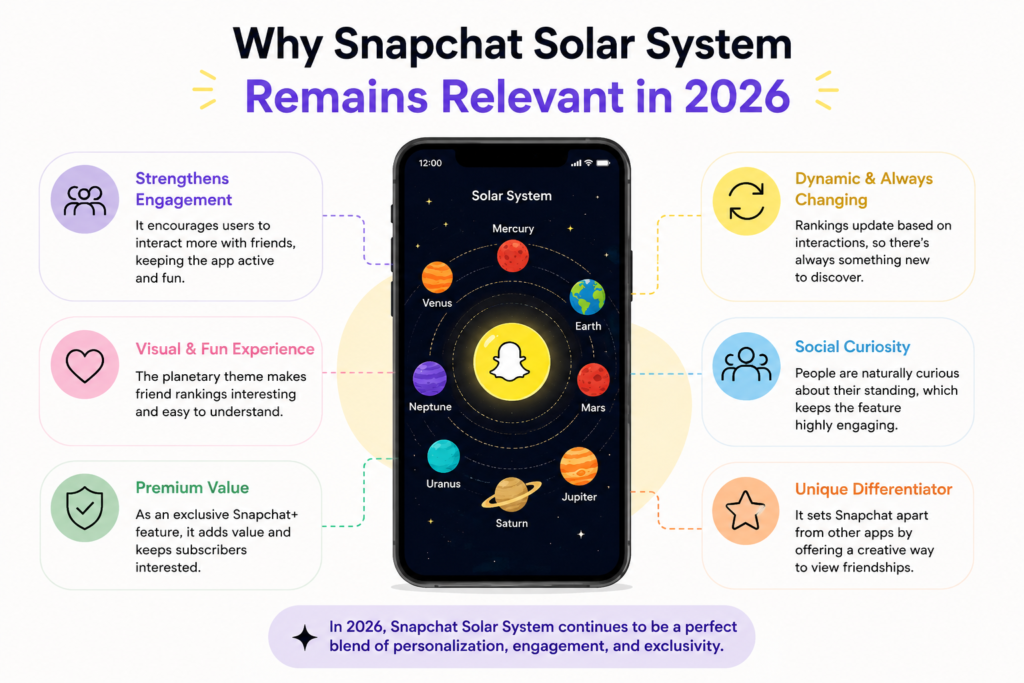
Even in 2026, the snapchat solar system continues to attract attention because it combines personalization with social interaction.
As Snapchat expands its premium features, the Friend Solar System remains one of the easiest ways for subscribers to visualize their closest connections.
Its colorful design, changing rankings, and unique planet themes make it one of Snapchat+’s most recognizable additions.
For users who enjoy discovering how their friendships evolve over time, the feature adds another layer of engagement that traditional friend lists cannot provide.
Conclusion
The snapchat solar system offers a creative way to represent your top eight friends through planets ranging from Mercury to Neptune. Although the system is based on interaction frequency rather than emotional closeness, it provides an entertaining glimpse into your Snapchat activity.
Understanding how the snapchat solar system works can help users interpret rankings more accurately and avoid common misunderstandings. Whether you’re curious about Mercury, confused about badges, or simply exploring Snapchat+, the feature remains one of the platform’s most fascinating additions in 2026.
Frequently Asked Questions
Does Snapchat Solar System require Snapchat+?
Yes. The feature is exclusive to Snapchat+ subscribers.
Which planet represents the number-one best friend?
Mercury represents your closest friend based on interactions.
Can rankings change over time?
Yes. Rankings update automatically according to recent activity.
Does the system reflect real friendships?
Not necessarily. It mainly measures digital interactions inside Snapchat.
Is Snapchat Solar System visible to everyone?
No. These rankings are private and are not publicly displayed.
